The principle of the additional hand drive
The hand drive should run in addition to the pedal drive. For this purpose, two hand-drive levers are installed, which go synchronously to the right or left, and thus take over the steering of the trike or quad. It is driven with the hands when needed, by moving one lever forward and the other reverse
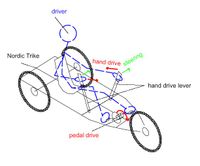
Principle representation of a Nordic Trike with hand drive
a) Steering:
Swivel to the left means curve to the left and vice versa. This steering movement is cleanly separated from the drive movement via a double joint, so that no matter where the levers are swivelled in the drive direction, the same steering system is always created. The handles swivel typical +- 75 mm from the center line for steering.
b) Hand drive:
In the direction of travel, both hand-drive levers are connected in such a way that when a lever is moved forward, the other swings backwards. For the driver, this means that one arm performs a pressure and the other one exercise movement, connects it via the upper body. The swivel path to the drive is measured in such a way that about 250 mm swinging path correspond to half a pedal rotation. The hand-drive levers once forward and back pivoting, then corresponds to an entire pedal rotation. Since the hand drive finally couples into the pedal drive via freewheel castors, the driver determines how the hand movement is synchronized to the pedal movement. This allows you to realize both a movement similar to the diagonal step during cross-country skiing (e.g. right leg in front of, right arm back) and a large number of other combinations.
While the adjustment of the wheel to the body dimensions is basically easily achieved by adjusting the saddle height on a bicycle, the hand drive of the Nordic trike must also be adjusted appropriately.
So first the driver's seat is moved until the legs can operate the pedal drive well. This is usually the case if the knee is not completely pushed through in the pedal position at the lowest pedal position.
Now the swivel range of the hand lever is adjusted so that the arm is not yet very straight in the front position. The following table gives an overview of the dimensions we use.
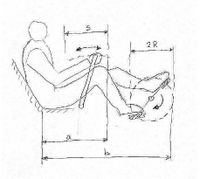
Typical measurements of a rider at a Nordic Trike
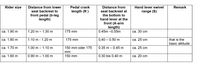
Overview of typical adjustment dimensions for hand and foot drive depending on body height
Handheld drive with ropes
Technically, there are a variety of possibilities for integrating the manual drive force. For this purpose, we have used a thin steel cable circulating around four deflection rollers, which is attached to the two hand drive levers, and with each forward and backward movement of the manual drive levers a piece on the right or on the left.
The pedal drive in the middle of the frame with its bottom bracket has received two external additional bearings with levers, so that a "crankshaft" similar to the car engine is created. On the outside of the bearings there are two cable pulleys on the crankshaft with an integrated freewheel, which further couple the respective cable force acting in the pedal step direction. This transfers hand and foot movement together to the chain to the rear wheel.
The transverse movement of the hand levers is tapped by a “cross joint” in each case and fed to the front wheel via a plurality of rods with joint heads.
The circumferential 2 mm steel cable is held tightly by a cable tensioner. It wraps around the cable pulleys on the crankshaft twice. Ca. 5,000 km have already been reached with a rope, without visible rope damage.
The hand-held drive variant with sails is particularly suitable for trikes and quads that have a body (partly or full body). All mechanical elements of the manual drive are located near the outer walls. Thus, the rather narrowly dimensioned interior is kept free for the driver.

View of the hand drive with the pedal crankshaft in the middle and the two hand drive levers outside
Manual drive solution in a compact box
The vast majority of the trikes and quads produced today have a lightweight tubular frame consisting of a few pipes. In the simplest case, this is a "T- or X-frame" consisting of a stable central tube with longitudinally adjustable pedal bearings and two transverse tubes to the front wheels.
Considerations to combine the manual drive in a compact, optionally installable transmission box have led to the right-hand version with the compact manual drive.
The pivoting movement of the hand levers is tapped off via two shafts coming from the middle transmission box and fed to a pinion located in the chain drive. The steering movement is guided parallel from the hand levers via two ball head rods underneath also to the middle of the frame. From there, front axles with one or two wheels can be steered over tie rods, as usual.
The compact hand drive can thus be installed on the frame tool in virtually all trike and quad variants.

Compact manual drive unit as a gear box in the middle of the frame (weight 25 kg, of which 5 kg manual drive)